

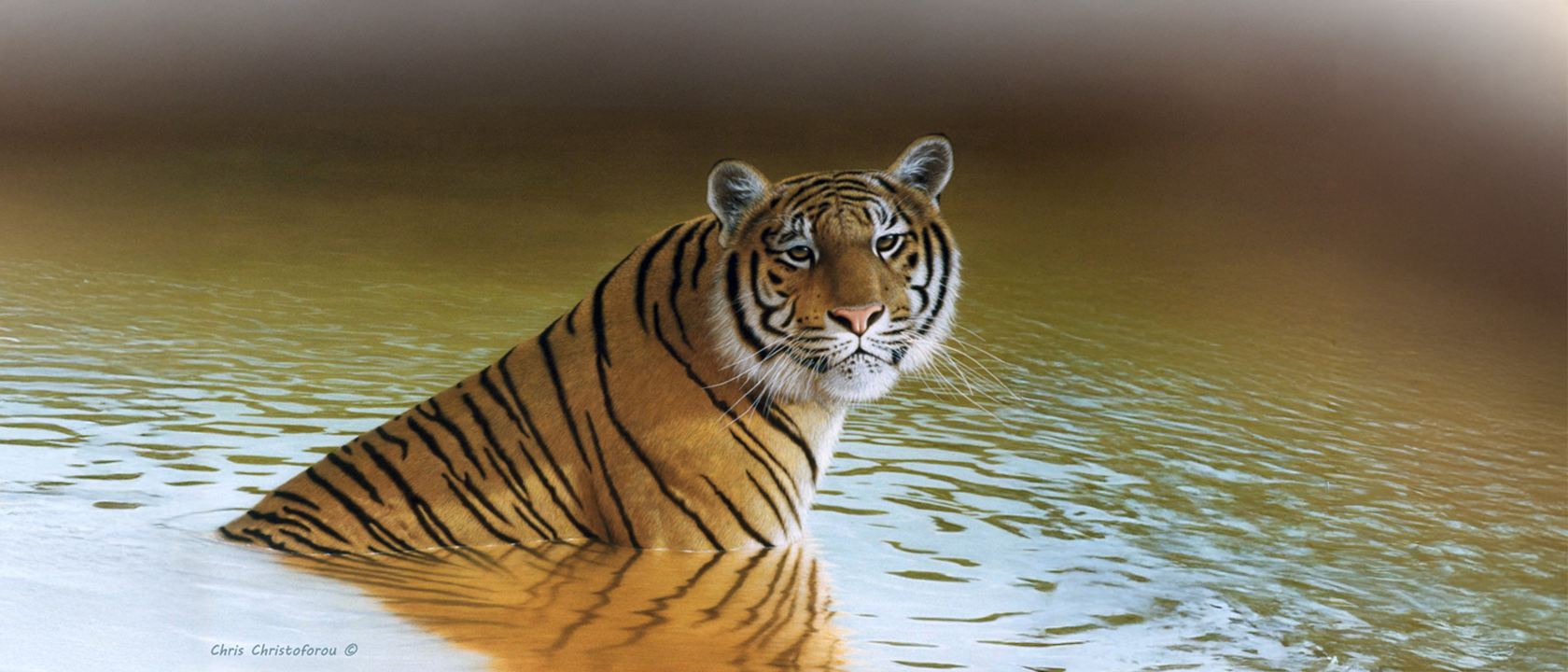
From Animation Cels to Wildlife Masterpieces: The Art of Chris Christoforou
In the world of professional art, few journeys are as fascinating as that of Chris Christoforou. A wildlife artist with an international reputation, Chris’s work is defined by a level of detail and luminosity that feels lifelike.
Long before Chris was tracking Bengal Tigers in Rajasthan or hand-rearing big cat, he was a commercial artist who used Chromacolour Cel Paint.
The Early Days: The Animation Connection
Chris started his career in the commercial world, where speed, precision, and vibrant colour were crucial. To give his work an edge, he turned to Chromacolour’s traditional animation paints.
At the time, our Cel Paints were designed for the world of animation feature films like Who Framed Roger Rabbit. They were famous for being "flat" (non-reflective), highly opaque, and incredibly consistent. For an artist like Chris, who was already developing a signature style focused on the intricate textures of fur and feathers, these paints offered a unique advantage. The paint's finish and the fact it could be layered without losing their brilliance.
Helping Chromacolour Evolve: Developing our Artists Paint
There was a problem with the Cel Paints and that was the fact the colours were tinted (contained black or white). This meant that Chris couldn't confidently mix them and instead had to rely on the extensive range of colours instead.
As the animation industry began its shift toward digital, Chris Christoforou played a pivotal role in the next chapter of our company history. He didn't want to see the unique properties of our Cel Paint disappear, but he knew that fine artists needed something more versatile than a traditional "tinted" animation pigment. They wanted a product that retained the Animation Paint's qualities, but could be mixed with predictable results.
Chris worked closely with the Chromacolour team to help develop our range of Artist Colours. He provided the artist’s perspective, testing how the paints behaved when blended, thinned for washes, or used for the ultra-fine detail required in wildlife portraiture.
The result was a paint that retained the legendary opacity and vibrancy of our animation roots but was reformulated for the canvas. Unlike the animation paints of the past, these were designed to be mixed predictably by the artist, allowing for the infinite variety of tones found in the natural world.
A Master of Reference and Realism
Today, Chris is well-known for his "hands-on" approach to art. He has lived with big cats full-time, helping to hand-rear young leopards and panthers to understand their anatomy from the inside out. This deep knowledge, combined with the paints he helped us perfect, allows him to create works that are both scientifically accurate and emotionally stirring.
Whether he is giving his popular "In Search of Tigers" talk or writing articles for major art magazines, Chris continues to be a champion for high-quality materials. He proves that while the medium may evolve from the animation desk to the gallery wall, the need for exceptional pigment never changes.

Share:
Animation Paper Sizes
Richard Williams